Product Detail Page
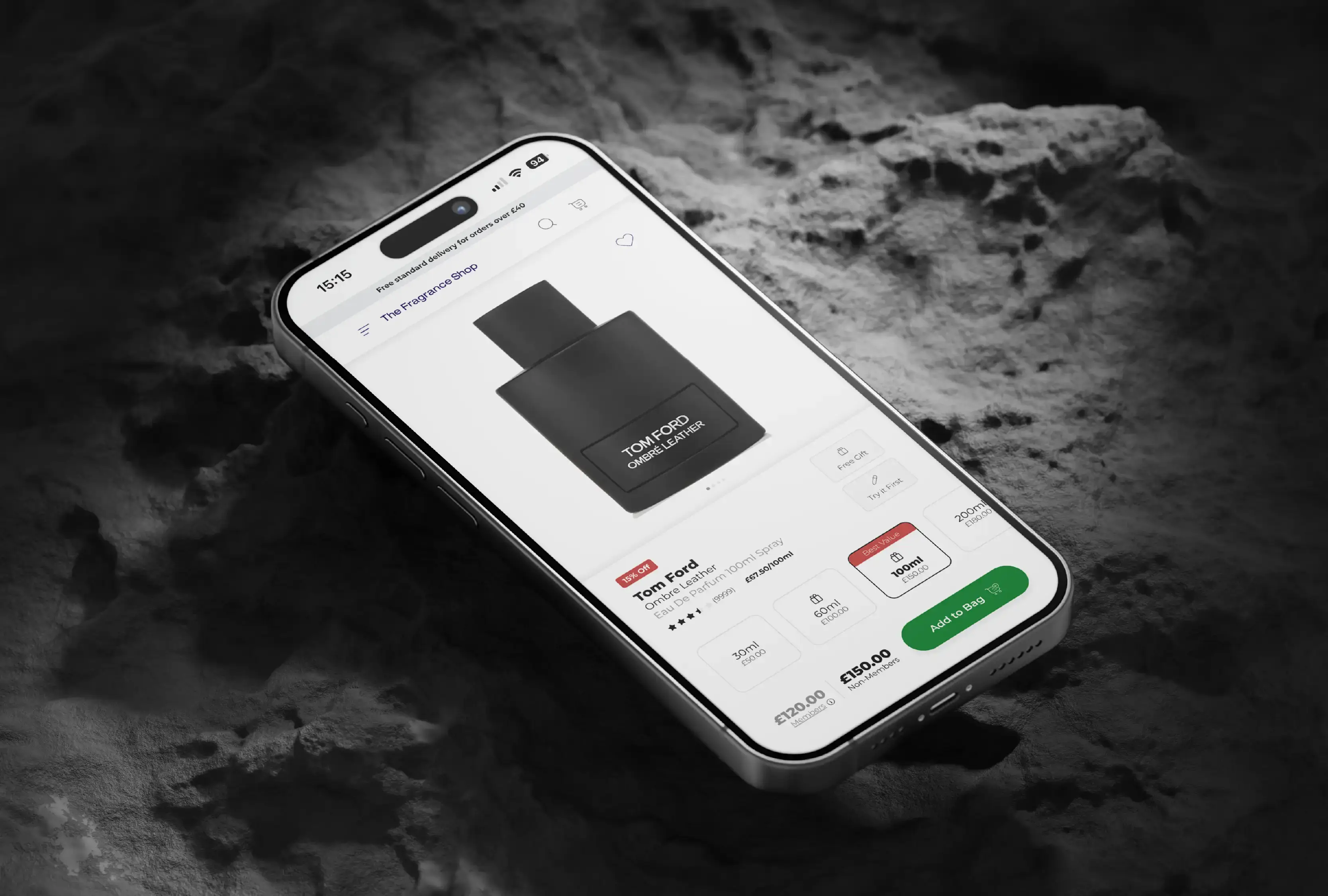
Led a mobile-first PDP transformation to resolve pricing friction, accelerate purchase intent, and embed conversion optimisation as a repeatable capability.
Overview
Situation
Context & Mandate
On joining The Fragrance Shop, one of the most critical commercial challenges was a sustained drop-off on the Product Detail Page (PDP), this page accounts for 45% of sessions and 42% of total site page views. As Principal-level design leadership, my mandate was not only to improve conversion, but to identify the highest-leverage intervention and establish a scalable PDP optimisation approach aligned with business growth.
With 91% of traffic arriving via mobile, the PDP was a core revenue surface with disproportionate impact.
Systemic Problem Definition
Rather than treating conversion loss as a surface-level UI issue, I reframed it as a decision-confidence and expectation-management problem:
Users could not act quickly due to CTA placement below the fold
Pricing logic prioritised business messaging over user clarity
Equal weighting of member and non-member prices created false expectations
Fragrance education assumed expert knowledge, increasing cognitive load
PDP intent was not aligned with checkout reality, breaking trust
This misalignment was creating avoidable friction at the moment of highest intent.
Evidence-Led Framing
To validate the problem and guide prioritisation, I synthesised insight across:
Guerrilla usability testing to capture real-world hesitation and confusion
Heatmapping to confirm scroll fatigue and CTA discoverability issues
GA4 funnel analysis to isolate PDP → basket drop-off
Controlled A/B testing to quantify behavioural change
This allowed me to separate symptoms from root causes and focus design effort where it would materially affect revenue.
Strategic Design Direction
At a principal level, the strategy was framed around three pillars:
1. Reduce Cognitive Load at the Moment of Commitment
Simplify choice, clarify price expectations, and remove unnecessary interpretation.
2. Align PDP Expectations with Checkout Reality
Ensure what users believe they are purchasing matches what they experience later in the funnel.
3. Design for Scale, Not One-Off Wins
Create PDP patterns that could be reused, tested, and evolved across categories.
Design
Leverage
Key Interventions
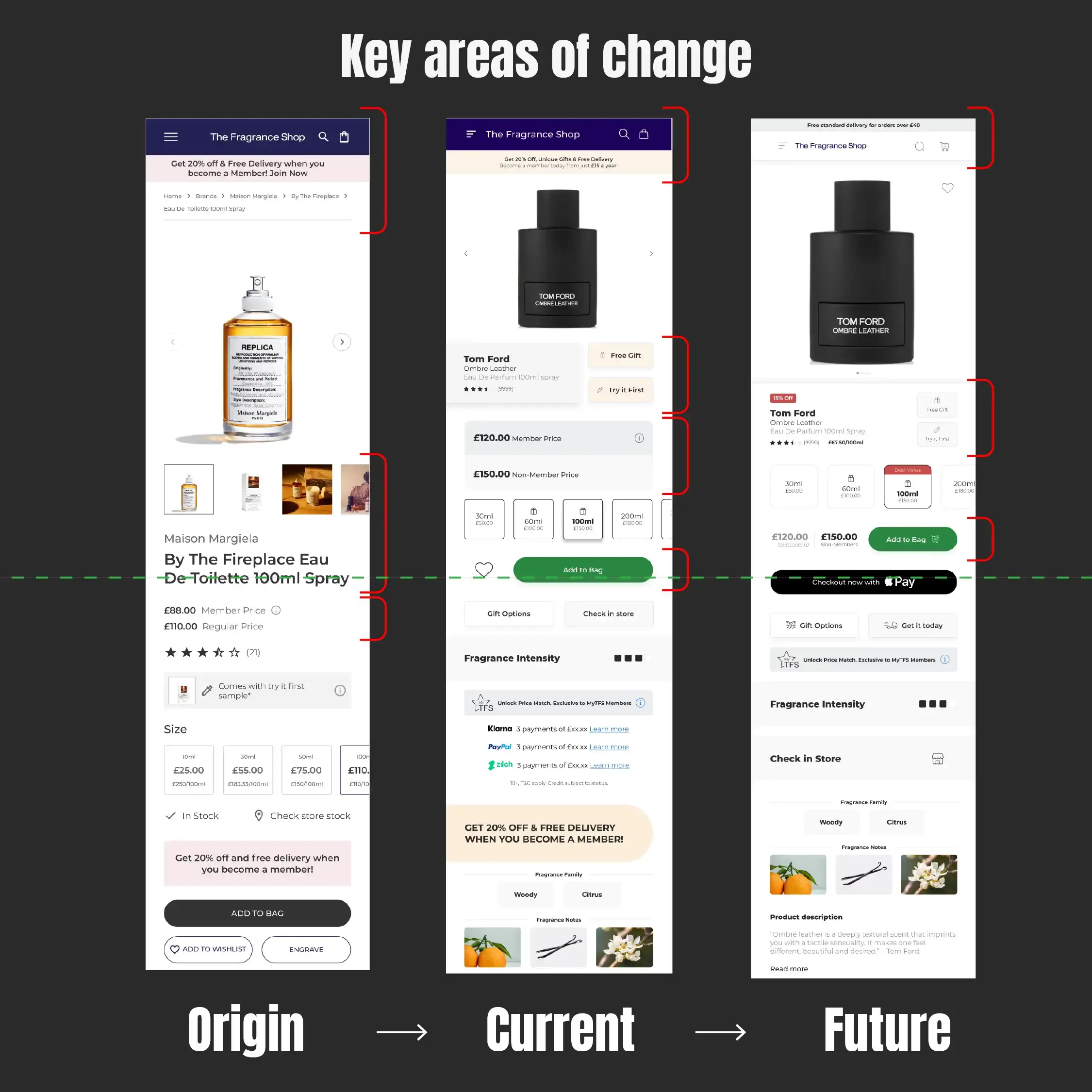
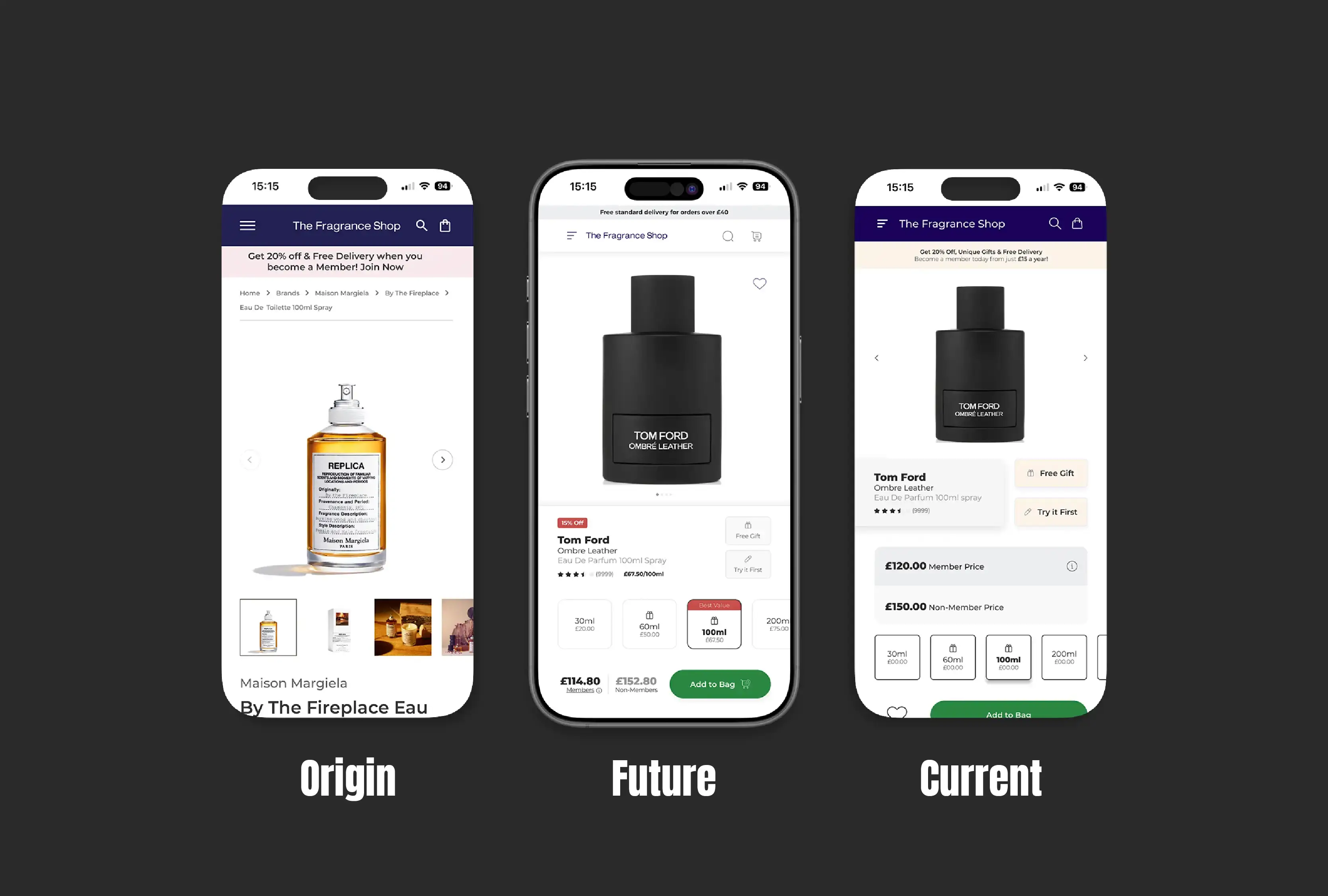
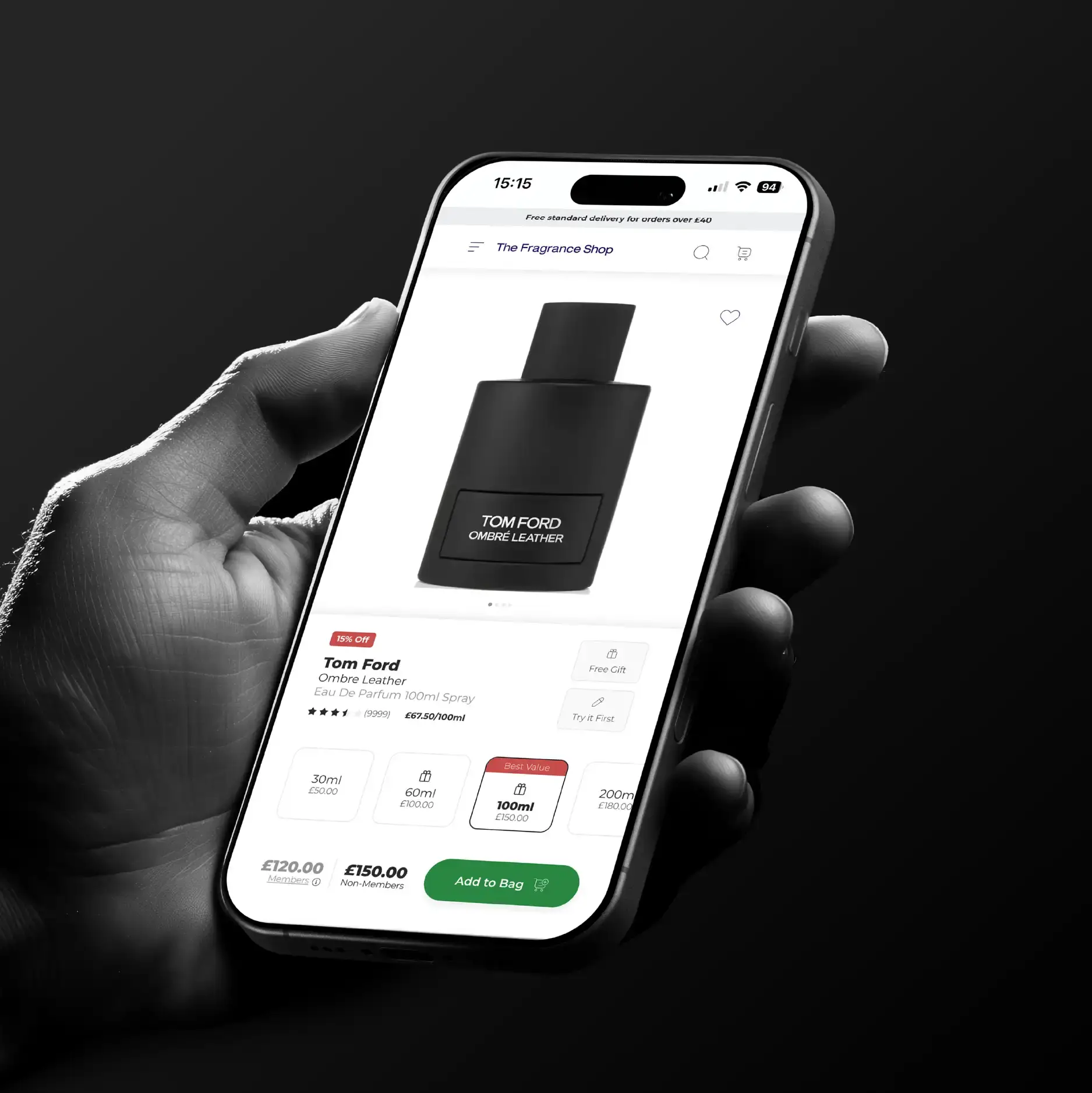
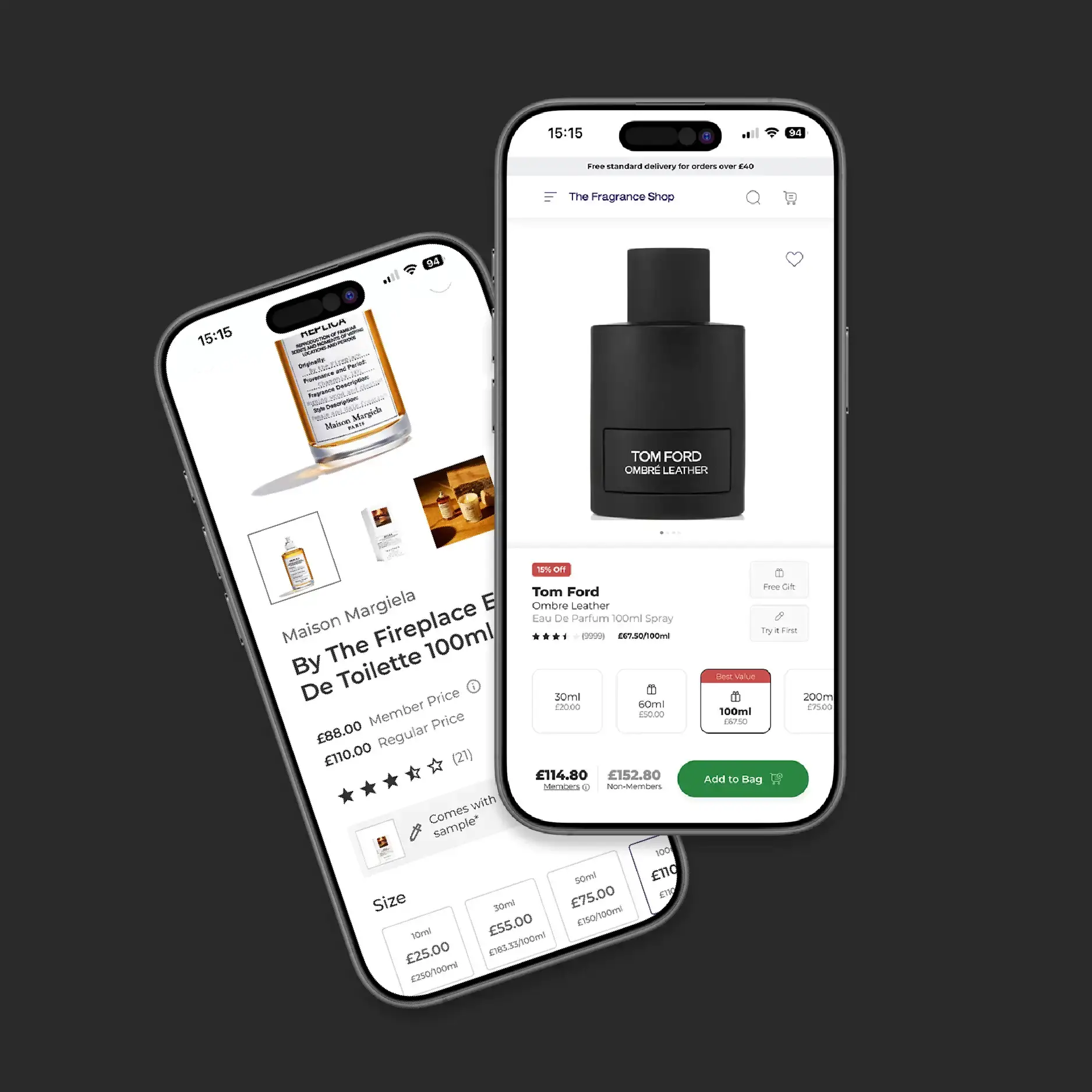
Re-architected pricing hierarchy to clearly distinguish member vs non-member value without misleading users
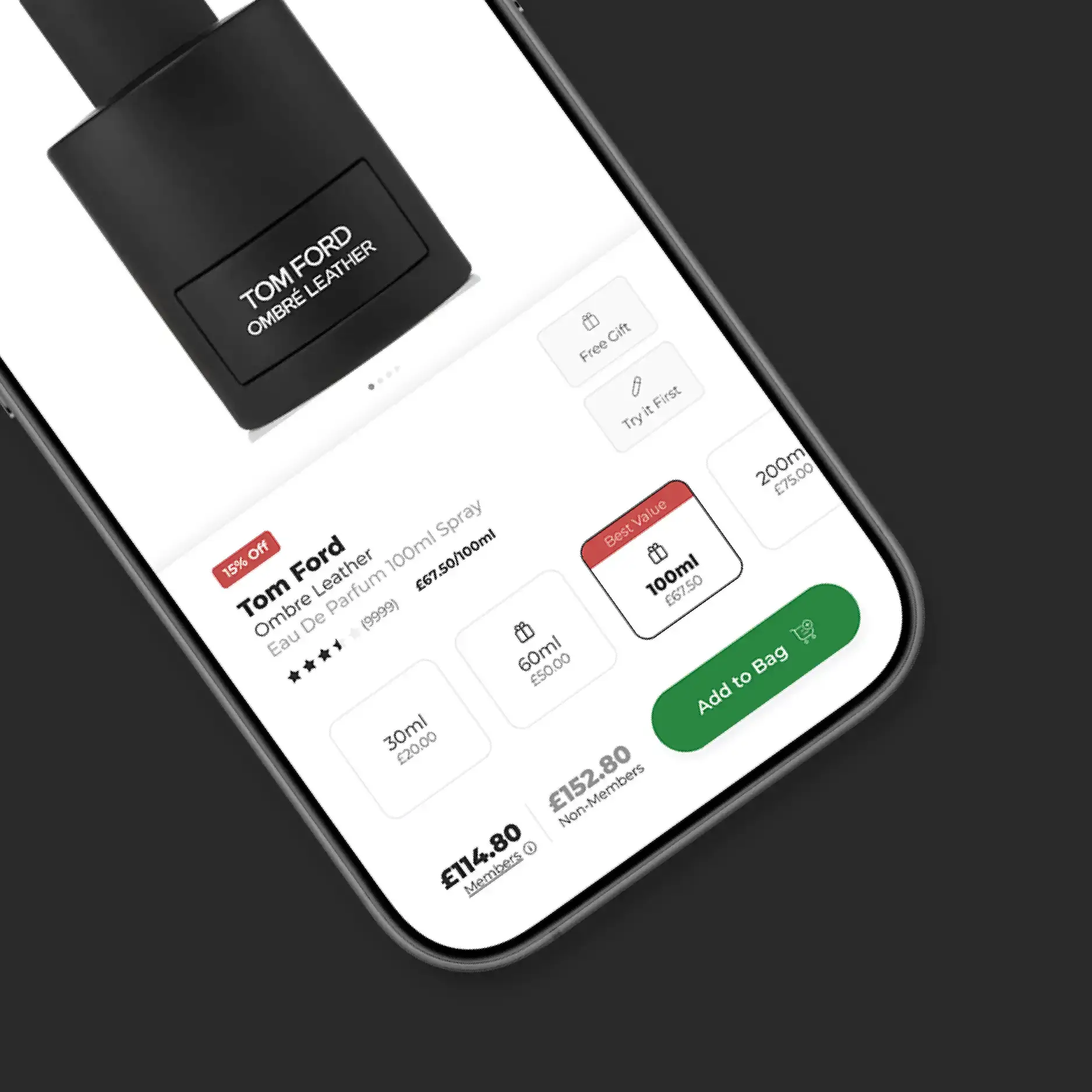
Elevated primary CTAs above the fold to shorten time-to-action, especially on mobile
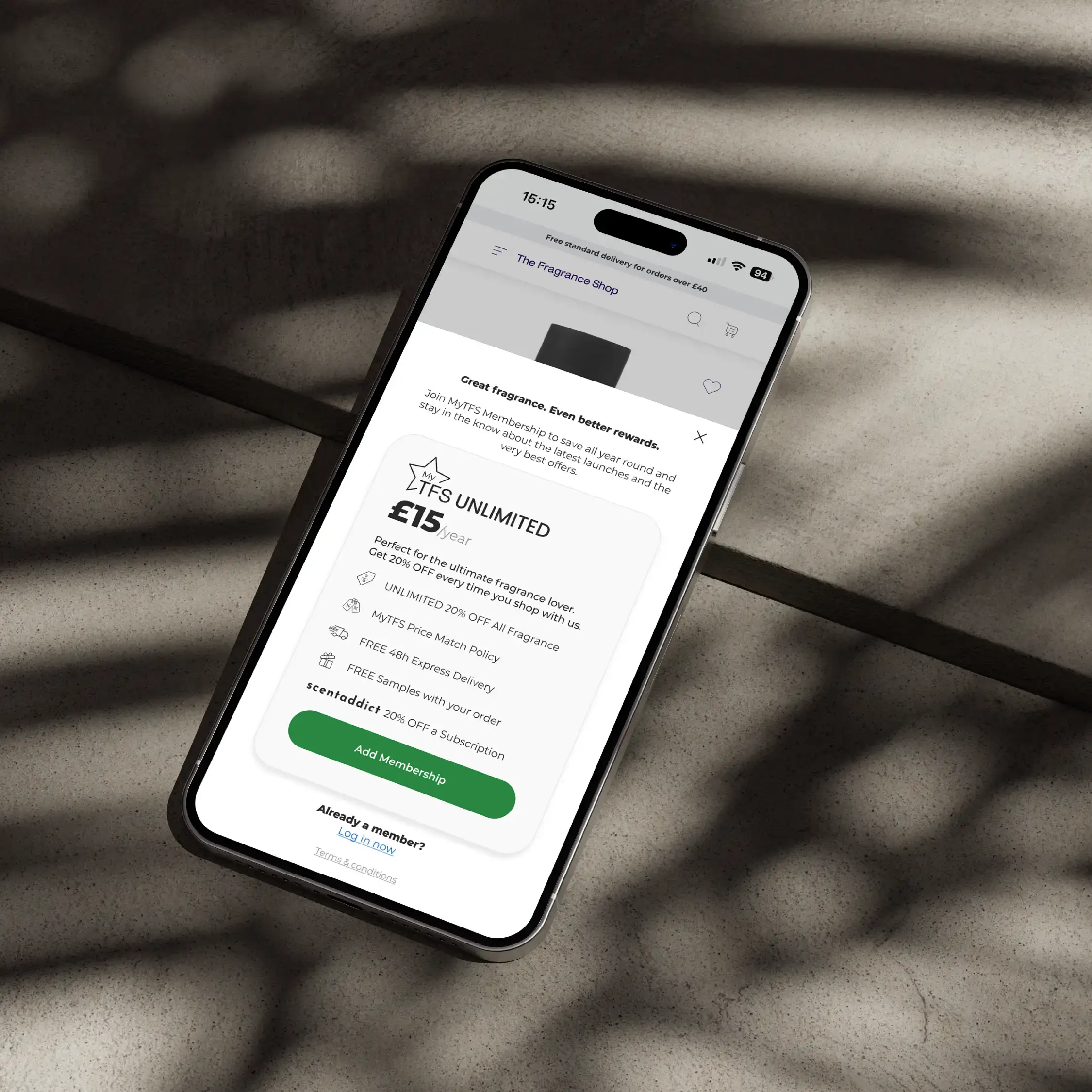
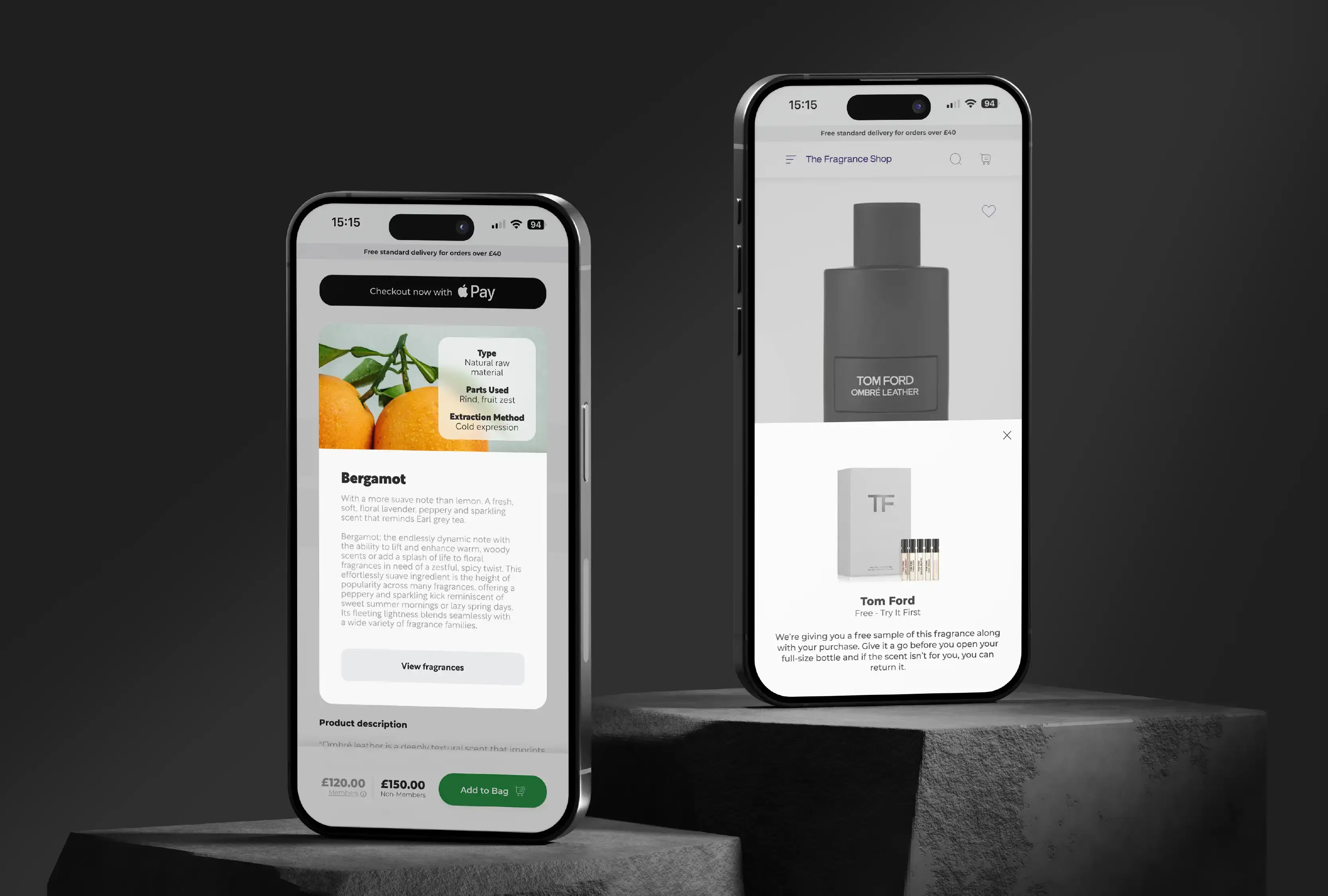
Introduced structured value communication (offers, gifts, incentives) to reinforce perceived benefit
Embedded fragrance education through lightweight, contextual explanations and visual notes rather than dense copy
Established mobile-first PDP patterns optimised for thumb reach, scanning, and speed
Each intervention was tested iteratively, with design decisions gated by behavioural data rather than opinion.
Impact
+15.8% uplift in PDP-to-checkout conversion
Reduced basket abandonment driven by pricing expectation mismatch
Improved user confidence for non-expert fragrance buyers
PDP optimisation approach adopted as part of a wider CRO roadmap
More importantly, this work shifted how PDP performance was evaluated, moving the organisation towards continuous experimentation rather than static redesigns.
Contribution
Defined the problem space and success metrics, not just the UI solution
Acted as a strategic partner to CRO, analytics, and engineering
Used experimentation to de-risk decisions and align stakeholders
Balanced short-term revenue gains with long-term user trust
Created reusable PDP patterns to support future growth initiatives
My Role & Seniority
This project demonstrates my ability to:
Identify the highest-impact design leverage points
Translate ambiguity into measurable outcomes
Influence product direction beyond a single feature
Use design as a driver of commercial performance at scale
Top 5 UX Wins
Five high-leverage PDP improvements focused on reducing friction at the moment of purchase, aligning user expectations with checkout reality, and embedding scalable conversion optimisation patterns across a mobile-first e-commerce experience.
01
Reframed the Conversion Problem
Why it matters:
By identifying pricing clarity and expectation mismatch as the true root cause (not just UI placement), design effort was focused on the highest-leverage friction, driving measurable revenue impact rather than surface-level optimisation.
02
Clarified Pricing Hierarchy
Why it matters:
Separating member and non-member pricing reduced cognitive load and checkout shock, improving user trust while still supporting subscription value in a transparent way.
03
Accelerated Time-to-Action
Why it matters:
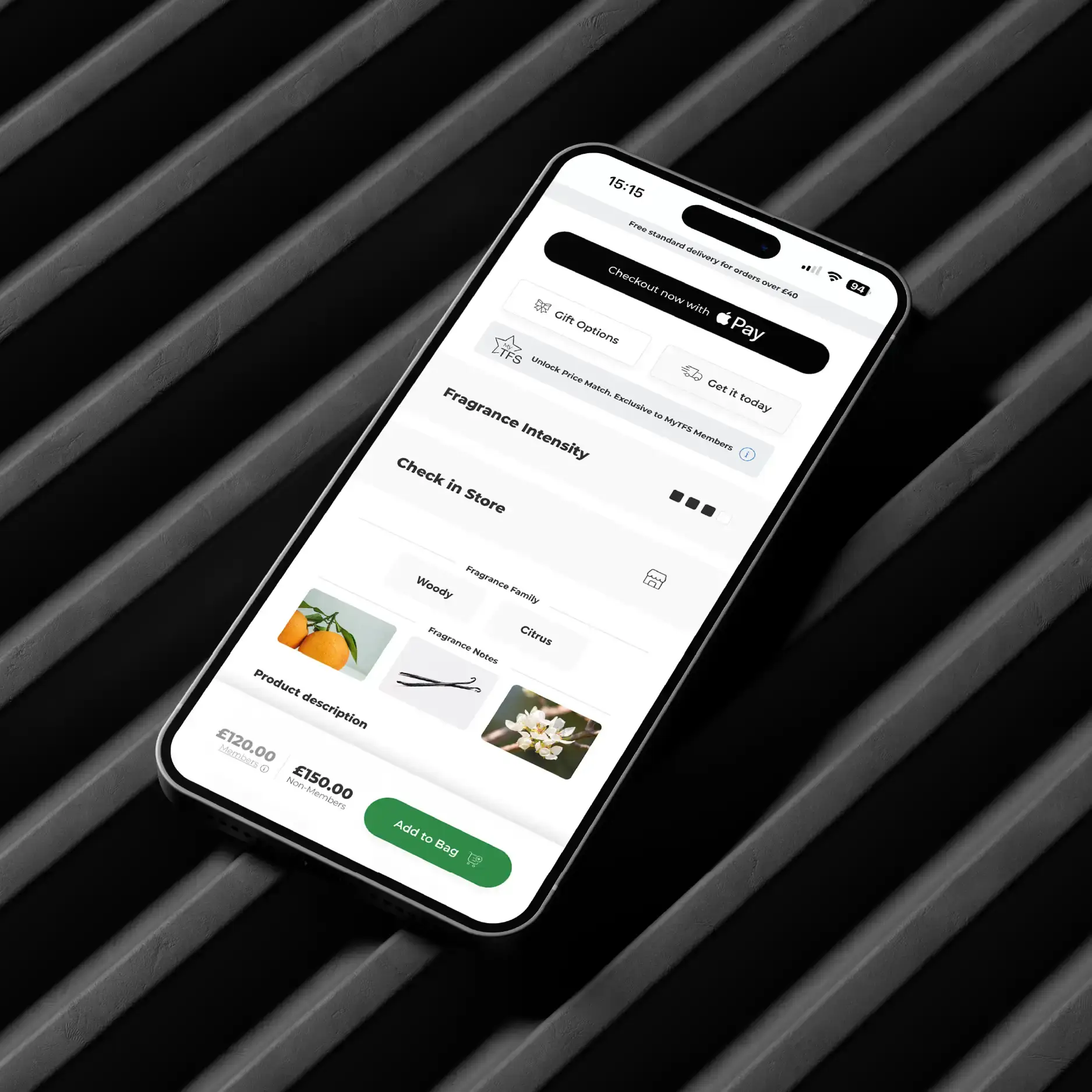
Moving the primary CTA above the fold shortened the path to purchase especially on mobile capturing high-intent behaviour earlier and improving conversion.
04
Established Mobile-First PDP Patterns
Why it matters:
Designing for the 91% of users arriving via mobile ensured impact matched real behaviour and created reusable patterns for future PDP and CRO work.
05
Increased Purchase Confidence
Why it matters:
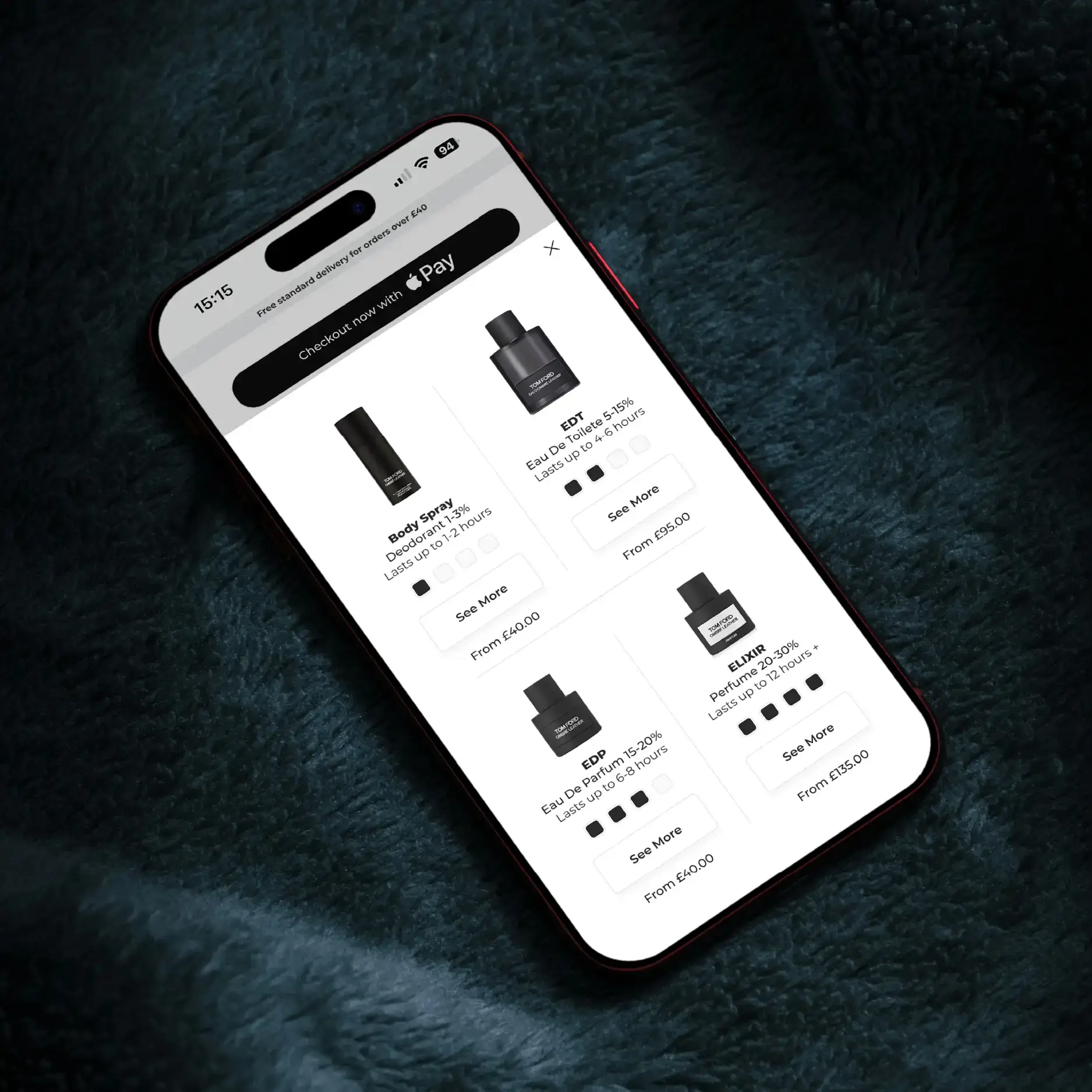
Lightweight fragrance education and visual cues reduced uncertainty for non-expert users, enabling faster, more confident purchase decisions.
Mobile
Prototype
This interactive mobile prototype demonstrates a focused end-to-end user journey.
Please note this is a design prototype, not a working site, and some interactions are out of scope.
Mobile
Prototype
Want to
see more?
Browse my other projects to explore how I approach UX, UI, and product design across a range of challenges.
Start Up - End to End
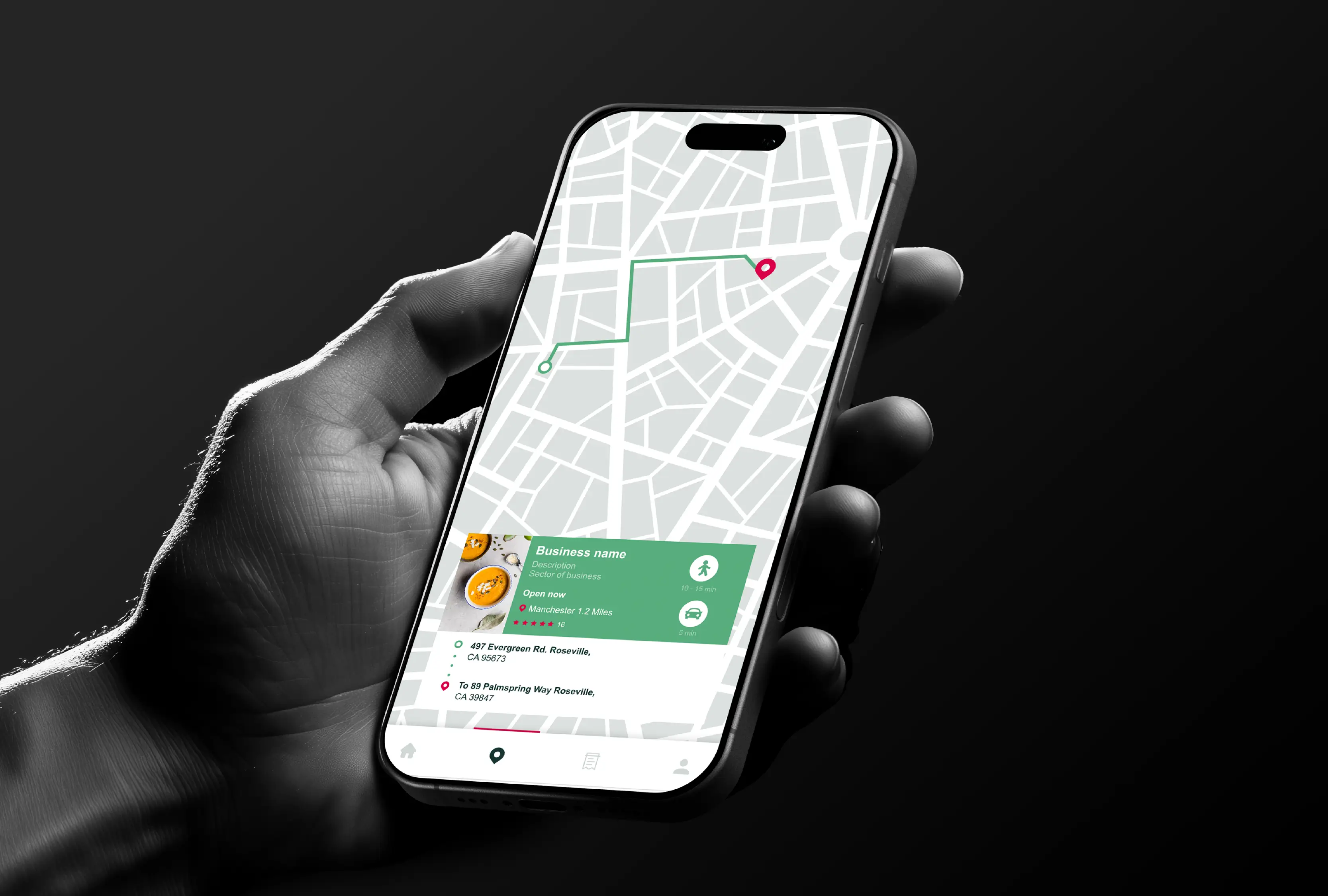
Find My Food app
Created the full UX, visual identity, and high-fidelity prototypes for an app concept from idea to execution.
Product Detail Page
Led a mobile-first PDP transformation to resolve pricing friction, accelerate purchase intent, and embed conversion optimisation as a repeatable capability.
Overview
Situation
Context & Mandate
On joining The Fragrance Shop, one of the most critical commercial challenges was a sustained drop-off on the Product Detail Page (PDP), this page accounts for 45% of sessions and 42% of total site page views. As Principal-level design leadership, my mandate was not only to improve conversion, but to identify the highest-leverage intervention and establish a scalable PDP optimisation approach aligned with business growth.
With 91% of traffic arriving via mobile, the PDP was a core revenue surface with disproportionate impact.
Systemic Problem Definition
Rather than treating conversion loss as a surface-level UI issue, I reframed it as a decision-confidence and expectation-management problem:
Users could not act quickly due to CTA placement below the fold
Pricing logic prioritised business messaging over user clarity
Equal weighting of member and non-member prices created false expectations
Fragrance education assumed expert knowledge, increasing cognitive load
PDP intent was not aligned with checkout reality, breaking trust
This misalignment was creating avoidable friction at the moment of highest intent.
Evidence-Led Framing
To validate the problem and guide prioritisation, I synthesised insight across:
Guerrilla usability testing to capture real-world hesitation and confusion
Heatmapping to confirm scroll fatigue and CTA discoverability issues
GA4 funnel analysis to isolate PDP → basket drop-off
Controlled A/B testing to quantify behavioural change
This allowed me to separate symptoms from root causes and focus design effort where it would materially affect revenue.
Strategic Design Direction
At a principal level, the strategy was framed around three pillars:
1. Reduce Cognitive Load at the Moment of Commitment
Simplify choice, clarify price expectations, and remove unnecessary interpretation.
2. Align PDP Expectations with Checkout Reality
Ensure what users believe they are purchasing matches what they experience later in the funnel.
3. Design for Scale, Not One-Off Wins
Create PDP patterns that could be reused, tested, and evolved across categories.
Design
Leverage
Key Interventions
Re-architected pricing hierarchy to clearly distinguish member vs non-member value without misleading users
Elevated primary CTAs above the fold to shorten time-to-action, especially on mobile
Introduced structured value communication (offers, gifts, incentives) to reinforce perceived benefit
Embedded fragrance education through lightweight, contextual explanations and visual notes rather than dense copy
Established mobile-first PDP patterns optimised for thumb reach, scanning, and speed
Each intervention was tested iteratively, with design decisions gated by behavioural data rather than opinion.
Impact
+15.8% uplift in PDP-to-checkout conversion
Reduced basket abandonment driven by pricing expectation mismatch
Improved user confidence for non-expert fragrance buyers
PDP optimisation approach adopted as part of a wider CRO roadmap
More importantly, this work shifted how PDP performance was evaluated, moving the organisation towards continuous experimentation rather than static redesigns.
Contribution
Defined the problem space and success metrics, not just the UI solution
Acted as a strategic partner to CRO, analytics, and engineering
Used experimentation to de-risk decisions and align stakeholders
Balanced short-term revenue gains with long-term user trust
Created reusable PDP patterns to support future growth initiatives
My Role & Seniority
This project demonstrates my ability to:
Identify the highest-impact design leverage points
Translate ambiguity into measurable outcomes
Influence product direction beyond a single feature
Use design as a driver of commercial performance at scale
Top 5 UX Wins
Five high-leverage PDP improvements focused on reducing friction at the moment of purchase, aligning user expectations with checkout reality, and embedding scalable conversion optimisation patterns across a mobile-first e-commerce experience.
01
Reframed the Conversion Problem
Why it matters:
By identifying pricing clarity and expectation mismatch as the true root cause (not just UI placement), design effort was focused on the highest-leverage friction, driving measurable revenue impact rather than surface-level optimisation.
02
Clarified Pricing Hierarchy
Why it matters:
Separating member and non-member pricing reduced cognitive load and checkout shock, improving user trust while still supporting subscription value in a transparent way.
03
Accelerated Time-to-Action
Why it matters:
Moving the primary CTA above the fold shortened the path to purchase especially on mobile capturing high-intent behaviour earlier and improving conversion.
04
Established Mobile-First PDP Patterns
Why it matters:
Designing for the 91% of users arriving via mobile ensured impact matched real behaviour and created reusable patterns for future PDP and CRO work.
05
Increased Purchase Confidence
Why it matters:
Lightweight fragrance education and visual cues reduced uncertainty for non-expert users, enabling faster, more confident purchase decisions.
Mobile
Prototype
This interactive mobile prototype demonstrates a focused end-to-end user journey.
Please note this is a design prototype, not a working site, and some interactions are out of scope.
Mobile
Prototype
Want to
see more?
Browse my other projects to explore how I approach UX, UI, and product design across a range of challenges.
Start Up - End to End
Find My Food app
Created the full UX, visual identity, and high-fidelity prototypes for an app concept from idea to execution.
Product Detail Page
Led a mobile-first PDP transformation to resolve pricing friction, accelerate purchase intent, and embed conversion optimisation as a repeatable capability.
Overview
Situation
Context & Mandate
On joining The Fragrance Shop, one of the most critical commercial challenges was a sustained drop-off on the Product Detail Page (PDP), this page accounts for 45% of sessions and 42% of total site page views. As Principal-level design leadership, my mandate was not only to improve conversion, but to identify the highest-leverage intervention and establish a scalable PDP optimisation approach aligned with business growth.
With 91% of traffic arriving via mobile, the PDP was a core revenue surface with disproportionate impact.
Systemic Problem Definition
Rather than treating conversion loss as a surface-level UI issue, I reframed it as a decision-confidence and expectation-management problem:
Users could not act quickly due to CTA placement below the fold
Pricing logic prioritised business messaging over user clarity
Equal weighting of member and non-member prices created false expectations
Fragrance education assumed expert knowledge, increasing cognitive load
PDP intent was not aligned with checkout reality, breaking trust
This misalignment was creating avoidable friction at the moment of highest intent.
Evidence-Led Framing
To validate the problem and guide prioritisation, I synthesised insight across:
Guerrilla usability testing to capture real-world hesitation and confusion
Heatmapping to confirm scroll fatigue and CTA discoverability issues
GA4 funnel analysis to isolate PDP → basket drop-off
Controlled A/B testing to quantify behavioural change
This allowed me to separate symptoms from root causes and focus design effort where it would materially affect revenue.
Strategic Design Direction
At a principal level, the strategy was framed around three pillars:
1. Reduce Cognitive Load at the Moment of Commitment
Simplify choice, clarify price expectations, and remove unnecessary interpretation.
2. Align PDP Expectations with Checkout Reality
Ensure what users believe they are purchasing matches what they experience later in the funnel.
3. Design for Scale, Not One-Off Wins
Create PDP patterns that could be reused, tested, and evolved across categories.
Design
Leverage
Key Interventions
Re-architected pricing hierarchy to clearly distinguish member vs non-member value without misleading users
Elevated primary CTAs above the fold to shorten time-to-action, especially on mobile
Introduced structured value communication (offers, gifts, incentives) to reinforce perceived benefit
Embedded fragrance education through lightweight, contextual explanations and visual notes rather than dense copy
Established mobile-first PDP patterns optimised for thumb reach, scanning, and speed
Each intervention was tested iteratively, with design decisions gated by behavioural data rather than opinion.
Impact
+15.8% uplift in PDP-to-checkout conversion
Reduced basket abandonment driven by pricing expectation mismatch
Improved user confidence for non-expert fragrance buyers
PDP optimisation approach adopted as part of a wider CRO roadmap
More importantly, this work shifted how PDP performance was evaluated, moving the organisation towards continuous experimentation rather than static redesigns.
Contribution
Defined the problem space and success metrics, not just the UI solution
Acted as a strategic partner to CRO, analytics, and engineering
Used experimentation to de-risk decisions and align stakeholders
Balanced short-term revenue gains with long-term user trust
Created reusable PDP patterns to support future growth initiatives
My Role & Seniority
This project demonstrates my ability to:
Identify the highest-impact design leverage points
Translate ambiguity into measurable outcomes
Influence product direction beyond a single feature
Use design as a driver of commercial performance at scale
Top 5 UX Wins
Five high-leverage PDP improvements focused on reducing friction at the moment of purchase, aligning user expectations with checkout reality, and embedding scalable conversion optimisation patterns across a mobile-first e-commerce experience.
01
Reframed the Conversion Problem
Why it matters:
By identifying pricing clarity and expectation mismatch as the true root cause (not just UI placement), design effort was focused on the highest-leverage friction, driving measurable revenue impact rather than surface-level optimisation.
02
Clarified Pricing Hierarchy
Why it matters:
Separating member and non-member pricing reduced cognitive load and checkout shock, improving user trust while still supporting subscription value in a transparent way.
03
Accelerated Time-to-Action
Why it matters:
Moving the primary CTA above the fold shortened the path to purchase especially on mobile capturing high-intent behaviour earlier and improving conversion.
04
Established Mobile-First PDP Patterns
Why it matters:
Designing for the 91% of users arriving via mobile ensured impact matched real behaviour and created reusable patterns for future PDP and CRO work.
05
Increased Purchase Confidence
Why it matters:
Lightweight fragrance education and visual cues reduced uncertainty for non-expert users, enabling faster, more confident purchase decisions.
Mobile
Prototype
This interactive mobile prototype demonstrates a focused end-to-end user journey.
Please note this is a design prototype, not a working site, and some interactions are out of scope.
Mobile
Prototype
Want to
see more?
Browse my other projects to explore how I approach UX, UI, and product design across a range of challenges.
Start Up - End to End
Find My Food app
Created the full UX, visual identity, and high-fidelity prototypes for an app concept from idea to execution.